Context: The GPS of AI-assisted development
Imagine knowing every road in the world and having a vehicle that can travel on any of them, but you don’t know where you are or which way to go to reach your destination. That’s how AI-assisted app development works without context.
When applied to systems and applications, context enables AI not only to generate code from isolated instructions, but also to understand the business intent behind each process. Rather than generating code based on statistical models, context adds systemic intelligence to AI, acting as a living map that encompasses its software architecture, data, APIs, and business logic.
Returning to the car analogy, context acts like a GPS system that knows your entire travel history, your preferred routes, and the roads you want to avoid. This allows you to reach your destination safely, more quickly, and at the lowest cost.
That is why the new corporate development standard, Agentic Systems Engineering —recently launched in March of this year by OutSystems—redefines low-code platforms as a governance layer for AI-assisted development. It is a framework designed to help organizations build, manage, and evolve critical business systems composed of AI agents that can plan and act in a secure and governed manner.
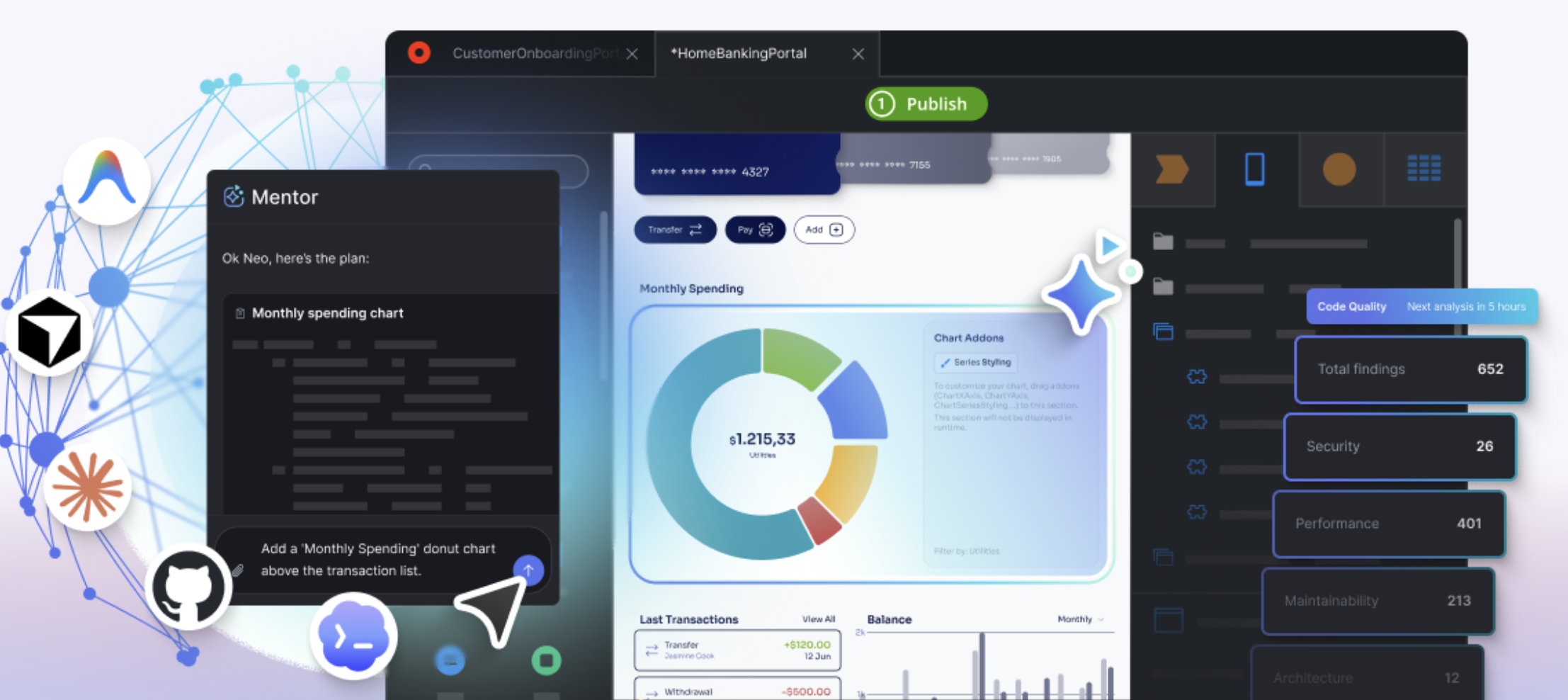
Agentic Systems Engineering consists of two main components: the Enterprise Context Graph, which acts as a “GPS,” providing AI agents with the context they need to create code and solutions safely and accurately; and the Mentor, which enables the generation and evolution of systems and applications through conversation.
The best part is that it’s an open system that can integrate with external solutions such as Cursor and Claude Code, unifying and ensuring compliance and auditability across the entire software development lifecycle in a single location. Through the AI Agent Builder, the OutSystems platform can create autonomous agents for various uses and specializations, based on any of the LLM models available on the market, giving companies the freedom to choose the AI providers that best fit their corporate strategy.
And the best part of all this is the increase in efficiency. When provided with a structured context, AI requires less effort and fewer tokens to guess what the business needs, and with fewer interactions between the developer and the AI, the final result is achieved in less time. Furthermore, with a clear roadmap, AI develops more assertively, adhering to best practices, correctly applying the company’s permission and security policies, and requiring much less work in post-development stages such as testing, deployment, maintenance, and evolution.
Developing any software—especially business-critical applications—is not just about writing lines of code; on the contrary, it requires a much broader range of skills, processes, and policies. Leaving AI in charge of development without the proper context and safeguards is like sitting in the back seat of a car and speeding toward an uncertain and dangerous destination—a destination from which it will be very difficult to return.